

Luke 13:1-9
With thanks to page sponsor Nancy Rockwell,
In appreciation for Textweek,
and the worldwide web of proclamation.
- Reading the Text:
- NRSV (with link to Anglicized NRSV) at Oremus Bible Browser.
- Greek Interlinear Bible, ScrTR, ScrTR t, Strong, Parsing, CGTS, CGES id, AV.
- The Bible Gateway: NRSV, RSV, NIV, NASB, CEV, The Message, KJV, etc.
- The Blue Letter Bible. KJV, alternate versions, Greek text with concordance, commentaries.
- The World Wide Study Bible includes commentary & sermons.
- Historical References, Commentary and
Comparative Texts:
- The Five Gospels Parallels, John W. Marshall, University of Toronto.
- Insurrection in the City under Pilate: New Testament Parallels to the Works of Josephus. From G.J. Goldberg's Flavius Josephus Home Page. (Some of these "parallels" are speculative.)
- IV.XXXVI.8, Adversus Haereses, Irenaeus of Lyons. (c. 180)
- From the
Geneva Notes.
- "Great and long suffering is the patience of God, but yet he eventually executes judgment."
- From
Matthew
Henry's Commentary (c. 1700).
- "The same Jesus that bids us repent, for the kingdom of heaven is at hand, bids us repent, for otherwise we shall perish."
- A Penitent Heart, the Best New Year's Gift (Luke 13:3): sermon by George Whitefield.
- From
Wesley's
Notes.
John Wesley
(1703-1791).
- "Either we may understand God the Father by him that had the vineyard , and Christ by him that kept it: or Christ himself is he that hath it, and his ministers they that keep it."
- From the
Commentary on the Whole Bible
(Jamieson, Fausset and Brown, 1871).
- "The final perdition of such as, after the utmost limits of reasonable forbearance, are found fruitless, will be pre-eminently and confessedly just"
- From
The
People's New Testament, B.W. Johnson, 1891.
- "A common fruit in Palestine. It represents here the Jewish nation."
- Contemporary Commentary, Studies, and Exegesis:
- Commentary,
Luke 13:1-9, (Lent 3C), Matt Skinner, Preaching This Week, WorkingPreacher.org, 2013.
- "Softly and tenderly Jesus is calling? Not here. This time it's loudly and pointedly."
- "Suffering, The Cross, and the Promise of Love," David Lose, ...in the meantime, 2016.
- "So what can we say in the face of suffering and loss? That God is with us. That God understands what our suffering is like...."
- "Longing for More," Karoline Lewis, Working Preacher, 2016.
- "It's hard to bear fruit when there's just not that much left to give."
- The Truett Pulpit, Angela Reed. 2016.
- "In this season of Lent, the church has an opportunity to seek restoration and renewal through the discipline of confession and heartfelt repentance."
- "A Plain Account",Troy Hochstetter, 2016.
- "Let's remember where we are in Luke's story: Jesus has decided to go to Jerusalem with a group of fellow Galilean pilgrims when they decide to share some news tainted with self-righteous anger."
- The Center for Excellence in Preaching, Scott Hoezee, resources from Calvin Theological Seminary: Comments & Observations, Textual Points, Illustration Ideas, 2016.
- "Bearing Fruit," David F. Sellery, 2016.
- If You Lived Here, You'd Be Home by Now, Stan Duncan, 2016.
- Pulpit Fiction, podcast. Reflections of lectionary text, pop culture, current events, etc. Robb Mc Coy and Eric Fistler, 2016.
- "How Much Does It Cost?" Janet H. Hunt, Dancing with the Word, 2016.
- "Where and how in your life do you "spend money for that which is not bread, and your labor for that which doe not satisfy? Where and how might you be called to 'spend' differently?"
- "Where Are the Figs?" Sharron R. Blezard, Stewardship of Life, 2016.
- "Meditations on Repentence," Andrew Prior, One Man's Web, 2016.
- "The Pornography of Pessimism," Nancy Rockwell, The Bite in the Apple, 2016.
- "It's terribly hard work to persuade people to hope."
- "Judgment and Forbearance," Glenn Monson, Law & Gospel Everywhere, 2016.
- "The call to follow Jesus in a life of love and justice is not explicitly present here. Having said that, it might follow quite naturally that if God is forbearing with us, we too need to show forbearance with others."
- "Seeking God," Alan Brehm, The Waking Dreamer, 2016.
- "The only way to seek God genuinely and with all our heart is to know in the depths of our soul that we need God in every aspect of our lives."
- Commentary,
Luke 13:1-9, (Lent 3C), Arland J. Hultgren, Preaching This Week, WorkingPreacher.org, 2013.
- "In the larger scheme of things, God’s grace is greater than God’s judgment."
- "How to Survive the Sequester, Syria, and Other Threatening Headlines," Matthew L. Skinner, ON Scripture, Odyssey Networks, 2013.
- "The word translated as 'repent' is, at its root, about thinking and perception. It refers to a wholesale change in how a person understands something. It implies an utter reconfiguration of your perspective on reality and meaning, including (in the New Testament) a reorientation of yourself toward God."
- "When Bad Things Happen," David Lose, Working Preacher, 2013.
- "So why do bad things happen to good, and sometimes not-so-good, people? Jesus doesn’t say and neither can we."
- "Theodicy or Hypocrisy?" D Mark Davis, raw translation and exegesis/questions, Left Behind and Loving It, 2013.
- "A fig tree in a vineyard. Are they compatible plantings so this is common or is this an oddity? (By the way, isn’t “fruitless fig” a great put-down?)"
- "Walking the Walk (of the Stataions of the Cross)," study guide for adults, Robert B. Kruschwitz, (other resources at) Lent, focus of "Christian Reflection," Baylor University Center of Christian Ethics, 2013. Focus article, "Walking the Walk (of the Stations of the Cross)," Carmen Aceedo Butchert.
- "Hold the Tension," Rev. Anne S. Howard, A Word in Time, The Beatitudes Society, 2013.
- "... Jesus could be saying in this fig tree parable, we cannot make life safe nor God tame. But in the darkness is the guide to the dawn; in the emptiness is the way to fulfillment; in the losing is the gain; in the dying is new life; in the folly is the wisdom—the wisdom of the cross."
- "Sadie, The Prayer Dog," Alyce M McKenzie, Edgy Exegesis, 2013.
- "The first nine verses of the thirteenth chapter of Luke are either sweet or sour, depending on how you look at them."
- "Thirsty," Melissa Bane Sevier, Contemplative Viewfinder, 2013.
- "The longings we have for depth of meaning, for companionship, for truth, for relief from things that burden us, for help when we feel helpless—all these longings find a home in us at some point or other."
- "Crushed!" Michael Danner, The Hardest Question, 2013.
(Also see "Crushed! Another View")
- "People get crushed in all kinds of ways, God has nothing to do with it!"
- Parable of the Barren Fig Tree, audio telling, story in episodes, graphic, audio and written commentaries. Go Tell Communications, Biblical Storytelling for the Global Village, 2013.
- "Falling Towers," Rick Morley, 2013.
- "We are all sinners. We all need to repent."
- "Yours Not Mine (Unless with Yours)," Michael Coffey, 2013.
- "Faithful Mercies," Alan Brehm, The Waking Dreamer, 2013.
- "When we struggle with faith in a world that can be heartbreaking, Jesus reminds us that God is the one who is with us in all our tragedy and our pain, sustaining us with mercies that are always faithful."
- Radical Gratitude, lectionary-based stewardship, Northwest United Methodist Foundation. (.pdf)
- Holy Textures, Understanding the Bible in its own time and in ours,
Luke 13:1-9, David Ewart, 2013.
- "In other words - Jesus is saying: In this life, undeserved bad things will happen to good people; and, in the life to come, deserved bad things will happen to bad people who don't repent now."
- "One More Year," the Rev. Dr. Janet H. Hunt, Dancing with the Word, 2013.
- "Why do you think the farmer in Jesus' story gives the fig tree one more year?"
- "Cultivating Change," Peter Woods, I Am Listening, 2013.
- "Succeeding in the Economy of God," Andrew Prior, First Impressions, 2013.
- "Wanting more, and living to get more and more, leads only to war and global warming. All the fruit falls from the trees in a drought of compassion. People become a commodity."
- Comentario del Evangelio por José Daniel Barahona Suazo, San Lucas 13:1-9, Working Preacher, 2013.
- Commentary,
Luke 13:1-9, (Lent 3C), Matt Skinner, Preaching This Week,
WorkingPreacher.org, 2010.
- "Repentance becomes less interesting when people mistake it to mean moral uprightness, expressions of regret, or a "180-degree turnaround." Rather, here and many other places in the Bible, it refers to a changed mind, to a new way of seeing things, to being persuaded to adopt a different perspective."
- Comments (commentary) and Clippings (technical notes for in-depth study), Chris Haslam, Anglican Diocese of Montreal.
-
"First
Thoughts on Year C Gospel Passages in the Lectionary,"
Lent 3,
William Loader, Murdoch University, Uniting Church in Australia.
- "?When authorities act harshly towards people, the people must deserve it? - that is one theology being addressed."
-
Exegetical
Notes by Brian Stoffregen at CrossMarks
Christian Resources.
- "I note that the 'sin' of the fig tree is not that it is doing something bad, but that it is doing nothing! It is just taking up space in the orchard."
-
Lectionary Blogging, John Petty, Progressive Involvement,
2010.
- "When it comes to running a vineyard, you have to figure that God knows what he's doing. But Christ protests. Turn it over to me. Let me try some forgiveness on that tree. Who knows? It might work. If it doesn't, I'll forgive it again from the cross. In no case, however, will I ever go back on the forgiveness I have pronounced on the world."
-
"The Pruning of the Barren Fig Tree,"
Gospel Analysis, Sermons from
Seattle, Pastor Edward F. Markquart, Grace Lutheran Church, Seattle,
Washington. Detailed background and exegesis.
- "Luke constructs the parable of the fig tree with an element of hope. There is still time for the fig tree to bear fruit. There is still time for your life to bear fruit."
- "The Spiritual Practice of Empathy," Melissa Bane Sevier, Contemplative Viewfinder, 2010. See also "The Acts of God," commentary on Luke 13:1-9.
-
"Sentenced to Life," Lee Koontz, Reflectious, 2010.
- "Even as we are condemned and pronounced guilty for our sinfulness and disobedience, we are loved and given a second chance."
-
"'It Is Not Certain," Peter Woods, I Am Listening, 2010.
- "Skilful religion, points to the mystery that is God with awe, instead of trying to explain everything with arrogance."
-
"Clarifying Moments of Warning and Invitation,"
The Journey with Jesus: Notes to Myself, Daniel B. Clendenin, Journey with
Jesus Foundation.
- "Why are so many clarifying moments experiences of pain, suffering, and loss?"
- Laterally Luke, by Brian McGowan, Anglican priest in Western Australia.
-
Kairos CoMotion Lectionary Discussion,
Luke 13:1-9, Wesley White. "A place of
conversation regarding Progressive Christianity."
- "Unless you pay attention in a different way than you have, you will perish as did those at a deliberate hand of violence or in another anonymous occasion of death."
-
"Do You Deserve What You Get?" Lent 3,
Fr. Gerry Pierse, C.Ss.R., from Sundays Into
Silence: Reflections on the Sunday Gospels in the Light of Christian
Meditation. Claretian Publications.
- "While there is no cause and effect between what happens to us and our good or bad behavior, we are still challenged to behave in a better way."
-
"The
Tough Question," Larry Broding's Word-Sunday.Com: A Catholic
Resource for This Sunday's Gospel. Adult Study, Children's Story, Family
Activity, Support Materials.
- "Why do people suffer in this life?"
-
"We
All Stand under God's Judgement," Rev. Bryan Findlayson, Lectionary Bible
Studies and Sermons, Pumpkin Cottage Ministry Resources.
- "What is the relationship between tragedy and sin?"
-
"Third Sunday in Lent: Luke 13:1-9," For the Renewal of Repentance: The
Lukan Texts for Lent, Gary M. Simpson, Texts in Context, Word & World,
Luther Northwestern Theological School, 1992.
- "We moderns (and postmoderns) are also adept at externalizing. In addition, our contemporary affection for the adequacy of causal explanations escalates our use of diversionary tactics."
-
Lectionary
Commentary and Preaching Paths (Lent C3), by Jirair Tashjian, at The
Christian Resource Institute.
- "It is true of course that sometimes God does act in judgment. However, our passage today argues against the view that tragedies in the world are routinely to be interpreted as a manifestation of the wrath of God or as the will of God."
- "The Fig Tree," wikipedia.
- Commentary,
Luke 13:1-9, (Lent 3C), Matt Skinner, Preaching This Week, WorkingPreacher.org, 2013.
- Recommended articles
from ATLAS, an online collection of religion and theology journals, are
linked below.
ATLAS Access options are available for academic institutions, alumni of
selected theological schools, and clergy/church offices. Annotated list of "starting place" articles at ATLAS for this week's texts (includes direct links).
- Bauckham, Richard,
"The Two Fig Tree Parables in the Apocalypse of Peter," Journal of
Biblical Literature, 1985.
EBSCO ATLASerials, Religion Collection
EBSCO ATLA Religion Database with ATLASerials - Blumenthal, David R.,
"Repentance and Forgiveness," Cross Currents, 1998.
EBSCO ATLASerials, Religion Collection
EBSCO ATLA Religion Database with ATLASerials - Curkpatrick, Stephen, "Parable Metonymy and Luke's Kerygmatic Framing,"
Journal for the
Study of the New Testament, 2003.
EBSCO ATLASerials, Religion Collection
EBSCO ATLA Religion Database with ATLASerials - Hays, Richard B.,
"On Hearing Bad News," The Christian Century, 1992.
EBSCO ATLASerials, Religion Collection
EBSCO ATLA Religion Database with ATLASerials - Hedrick, Charles W.
"Prolegomena to Reading Parables: Luke 13:6-9 As A Test Case,"
Review & Expositor, 1997.
EBSCO ATLASerials, Religion Collection
EBSCO ATLA Religion Database with ATLASerials - Hedrick, Charles W.,
"An Unfinished Story about a Fig Tree in a Vineyard (Luke 13:6-9),"
Perspectives in Religious Studies, 1999.
EBSCO ATLASerials, Religion Collection
EBSCO ATLA Religion Database with ATLASerials - Hill, E. Wayne and Paull M. Mullen,
"Contexts for Understanding Forgiveness and Repentance as Discovery: A
Pastoral Care Perspective," The Journal of Pastoral Care, 2000.
EBSCO ATLASerials, Religion Collection
EBSCO ATLA Religion Database with ATLASerials - Long, Thomas G.,
"Breaking and Entering," The Christian Century, 2001.
EBSCO ATLASerials, Religion Collection
EBSCO ATLA Religion Database with ATLASerials - Rittenhouse, Bruce P., "What Does It
Mean to Tell the Truth about the Virginia Tech Killings?" Currents in
Theology and Mission, 2007.
EBSCO ATLASerials, Religion Collection
EBSCO ATLA Religion Database with ATLASerials - Shirock, Robert J.,
"The Growth of the Kingdom in light of Israel's Rejection of Jesus:
Structure and Theology in Luke 13:1-35," Novum Testamentum, 1993.
EBSCO ATLASerials, Religion Collection
EBSCO ATLA Religion Database with ATLASerials - Simpson, Gary M.,
"For the Renewal of Repentance: The Lukan Texts for Lent," Word &
World, 1992.
EBSCO ATLASerials, Religion Collection
EBSCO ATLA Religion Database with ATLASerials - Taylor, Barbara Brown,
"Life-giving Fear," The Christian Century, 1998.
EBSCO ATLASerials, Religion Collection
EBSCO ATLA Religion Database with ATLASerials - Wenig, Margaret Moers,
"The Jewish Laws of Repentance and Forgiveness," The Living Pulpit,
1994.
EBSCO ATLASerials, Religion Collection
EBSCO ATLA Religion Database with ATLASerials - Young, Franklin W.,
"Luke 13:1-9, Expository Article," Interpretation, 1977.
EBSCO ATLASerials, Religion Collection
EBSCO ATLA Religion Database with ATLASerials
- Bauckham, Richard,
"The Two Fig Tree Parables in the Apocalypse of Peter," Journal of
Biblical Literature, 1985.
- Sermons:
- "Spared the Ax," the Rev. Joseph Evans, Day 1, 2013.
- "Beyond What's Fair," Rev. Dr. Robert Dunham, Day 1, 2010.
- "Changing Your Mind, Bearing Fruit," the Rev. Dr. James B. Lemler, Day 1, 2007.
- "Wanted: Fig Trees that Produce Figs," Pastor Edward F. Markquart, Sermons from Seattle.
- "Missing Is Not Final," the Rev. Dr. Wiley Stephens, Day 1, 2004.
- "Could This Be the Year for Figs?" the Rev. Barbara K. Lundblad, Day 1, 2001.
- Father Andrew Greeley, Author, Priest, Sociologist: Background and Homily
- With Children:
- Worshiping with Children, Lent 3C, Including children in the congregation's worship, using the Revised Common Lectionary, Carolyn C. Brown, 2016.
- "Storypath Lectionary Links: Connecting Children's Literature with our Faith Story," 2016, Union Presbyterian Seminary.
- "The Fruitful Life," children's sermon, coloring page. Charles Kirkpatrick, Sermons 4 Kids.
- "What Kind of Dirt Are You?" Linda Edwards, The Children's Chapel.
- "Jesus Gives a Fig Tree a Second Chance," Sunday School Lessons: Family Bible Study, art projects, music, stories, etc.
- Drama:
- "A Raging 'C'," J'son M. Lee, dramatix.
- Graphics & Bulletin Materials:
- Clip Art, Luke 13:9, Fr. Richard Lonsdale, Resources for Catholic Educators.
- Clip Art Images: Luke 13:1-9, Luke 13:1-9 #2, Misioneros Del Sagrado Corazón en el Perú.
- Luke 13:1-9, Luke 13:1-9, Liturgical Drawing, Maria d.c. Zamora, Claretian Resources, Philippines. ("Download and use these for free.")
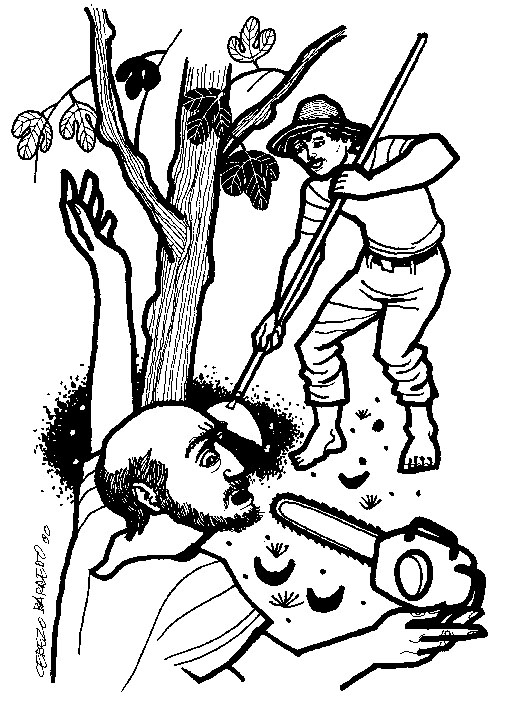
- Luke 13:1-9 at Cerezo Barredo's weekly gospel illustration. Liberation emphasis.
- Hymns and Music:
- 'One Day, the News was Grim,' Text: Carolyn Winfrey Gillette, Tune: LEONI 6.6.8.4 ("The God of Abraham Praise") A new hymn based on Luke 13:1-11.
- Hymnary.org, hymns, scores, media, information.
- Contemporary/Praise Song suggestions, Together to Celebrate, David MacGregor.
- Hymns with Scripture Allusions: Luke 13:3. The Cyber Hymnal.
- Fine Arts Images Linked at The Text This Week's Art Index:
- Movies scenes with the following themes, listed at The Text This Week's Movie Concordance:
- Find Worship Resources & Suggested Other Readings for use with this text:
- Study Links and Resources for the Book of Luke